|
|
|
|
|
|||
|
|||
|
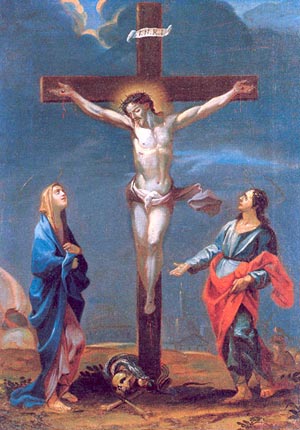
TWELFTH STATION V/. Adoramus te, Christe, et benedicimus tibi. From the Gospel according to John 19:19-20 Pilate also wrote a title and put it on the Cross; it read, Jesus of Nazareth, the King of the Jews. Many of the Jews read this title, for the place where Jesus was crucified was near the city; and it was written in Hebrew, in Latin, and in Greek. From the Gospel according to Matthew 27:45-50,54 Now from the sixth hour there was darkness over all the land until the ninth hour. And about the ninth hour Jesus cried with a loud voice, Eli, Eli, lama sabachthani? That is, My God, my God, why have you forsaken me? And some of the bystanders hearing it said, This man is calling Elijah. And one of them at once ran and took a sponge, filled it with vinegar, and put it on a reed, and gave it to him to drink. But the others said, Wait, let us see whether Elijah will come to save him. And Jesus cried again with a loud voice and yielded up his spirit. When the centurion and those who were with him, keeping watch over Jesus, saw the earthquake and what took place, they were filled with awe, and said, Truly this was the Son of God! MEDITATION In Greek and Latin, the two international languages of the time, and in Hebrew, the language of the Chosen People, a sign stood above the Cross of Jesus, indicating who he was: the King of the Jews, the promised Son of David. Pilate, the unjust judge, became a prophet despite himself. The kingship of Jesus was proclaimed before all the world. Jesus himself had not accepted the title Messiah, because it would have suggested a mistaken, human idea of power and deliverance. Yet now the title can remain publicly displayed above the Crucified Christ. He is indeed the king of the world. Now he is truly lifted up. In sinking to the depths he rose to the heights. Now he has radically fulfilled the commandment of love, he has completed the offering of himself, and in this way he is now the revelation of the true God, the God who is love. Now we know who God is. Now we know what true kingship is. Jesus prays Psalm 22, which begins with the words: My God, my God, why have you forsaken me? (Ps 22:2). He takes to himself the whole suffering people of Israel, all of suffering humanity, the drama of Gods darkness, and he makes God present in the very place where he seems definitively vanquished and absent. The Cross of Jesus is a cosmic event. The world is darkened, when the Son of God is given up to death. The earth trembles. And on the Cross, the Church of the Gentiles is born. The Roman centurion understands this, and acknowledges Jesus as the Son of God. From the Cross he triumphs ever anew. PRAYER Lord Jesus Christ, at the hour of your death the sun was darkened. Ever anew you are being nailed to the Cross. At this present hour of history we are living in Gods darkness. Through your great sufferings and the wickedness of men, the face of God, your face, seems obscured, unrecognizable. And yet, on the Cross, you have revealed yourself. Precisely by being the one who suffers and loves, you are exalted. From the Cross on high you have triumphed. Help us to recognize your face at this hour of darkness and tribulation. Help us to believe in you and to follow you in our hour of darkness and need. Show yourself once more to the world at this hour. Reveal to us your salvation.
All: Pater noster, qui es in cælis: Fac me vere tecum flere,
© Copyright 2005 - Libreria Editrice Vaticana
|
 |