| 
SR. ELENA MARIA MANGANELLI, O.S.A.
VIA CRUCIS
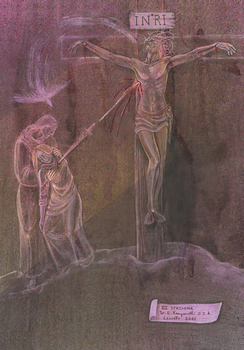
LECCETO 2011 TWELFTH STATION
Jesus dies on the cross Jesus experiences his death as a gift of love V/. We adore you, O Christ, and we bless you.
R/. Because by your holy cross you have redeemed the world. From the Gospel according to John 19:28-30 Jesus, knowing that all was now finished, said to fulfil the Scripture: “I thirst.” A bowl full of vinegar stood there; so they put a sponge full of the vinegar on hyssop and held it to his mouth. When Jesus had received the vinegar, he said, “It is finished”; and he bowed his head and gave up his spirit. * * * “I thirst.” “It is finished.” With these two phrases Jesus, looking first to humanity and then to the Father, bequeaths to us the burning passion at the heart of his person and mission: love for man and obedience to the Father. His is a love both horizontal and vertical: in the shape of the cross! And at the intersection of this twofold love, at the place where Jesus bows his head, the Holy Spirit wells up, the first fruits of his return to the Father.
This final breath which brings Jesus’ life to completion evokes the work of creation,[1] which now is redeemed. But it is also a summons to all of us who believe in him to “bring to completion in our own flesh what is lacking in Christ’s afflictions”.[2] That all may be complete! Lord Jesus, who died for our sake!
You ask, that you may give,
you die, that you may leave a legacy,
and thus you make us see that the gift of self
opens a space for unity.
Pardon the gall of our rejection and unbelief,
pardon the deafness of our hearts
to your cry of thirst
which echoes in the suffering of our many brothers and sisters. Come, Holy Spirit,
parting gift of the Son who dies for us:
may you be the guide who “leads us into all the truth”[3]
and “the root which sustains us in unity”![4]
All: Pater noster, qui es in caelis:
sanctificetur nomen tuum;
adveniat regnum tuum;
fiat voluntas tua, sicut in caelo, et in terra.
Panem nostrum cotidianum da nobis hodie;
et dimitte nobis debita nostra,
sicut et nos dimittimus debitoribus nostris;
et ne nos inducas in tentationem;
sed libera nos a malo. Vidit suum dulcem Natum
morientem desolatum,
cum emisit spiritum.
[4] Cf. Commentary on the Psalms, 143, 3.
© Copyright 2011 - Libreria Editrice Vaticana |



