|
|
|
|
|
|||
|
|||
|
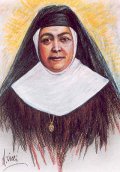
Bonifacia Rodríguez Castro (1837-1905) Bonifacia Rodríguez Castro is a simple worker who, in the midst of everyday life, opens herself to the gift of God, allowing it to grow in her heart with attitudes authentically evangelical. Faithful to the call of God, she abandons herself to the Father's arms, allowing him to imprint on her the features of Jesus, the worker of Nazareth, who lives hidden the great part of his life in the company of his parents. She is born in Salamanca, Spain, on June 6, 1837, in the bosom of an artisan family. Her parents, Juan and Maria Natalia, were deeply Christian, having foremost in their mind the education in faith of their six children among whom Bonifacia was the eldest. Her first school is the home of her parents, where Juan, a tailor, had installed his sewing shop, which is for Bonifacia the first thing she sees upon birth. Having completed her primary studies, she learns the trade of cord-making, with which she starts earning a living by working for others at the age of fifteen, upon the death of her father, in order to help her mother support the family. The need to work in order to live, shapes early on her solid personality, experiencing in her own body the hard conditions of the woman worker of the age: exhausting work schedule and meager pay. After having overcome the first financial difficulties, Bonifacia puts up her own cord-shop, passementerie and other needlework, wherein she works with the greatest recollection possible and imitates the hidden life of the Family of Nazareth. She had great devotion to Mary Immaculate and St. Joseph, the two current devotions, after the proclamation of the dogma of the Immaculate Conception in 1854 and the declaration of St. Joseph as the patron of the universal Church in 1870. From 1865, the wedding date of Agustina, the only one among her siblings who reached adulthood, Bonifacia and her mother, who had been left alone, dedicated themselves to a life of intense piety, going everyday to the nearby Clerecía, the church ran by the Society of Jesus. A group of girls from Salamanca, her friends, attracted by the witness of her life, begin to meet in her house-shop in the afternoon of Sundays and feast days in order to avoid dangerous forms of entertainment of the time. They found in Bonifacia a friend who would help them. Together they decide to form the Association of the Immaculate and St. Joseph, later called Josephine Association. Thus, the shop of Bonifacia acquires a clear apostolic and social dimension of preventing the woman worker from being led astray. Bonifacia feels called to religious life. Her great devotion to Mary continues to nurture in her heart the dream of becoming a Dominican in the convent of Sta. Maria de Dueñas in Salamanca. But a momentous event will change the course of her life: the encounter with a Catalan Jesuit Francisco Javier Butiña y Hospital, native of Bañolas-Gerona (1834-1899), who arrives in Salamanca in October of 1870 with a great apostolic concern toward the world of manual workers. He was writing for them The Light of the Manual Worker, a collection of life stories of distinguished faithful who sanctified themselves in humble occupations. Attracted by his evangelizing message about the sanctification of work, Bonifacia puts herself under his spiritual direction. Through her, Butiña gets in contact with the young women who frequented her shop, majority of whom are also manual workers. And the Holy Spirit moves him to found a new congregation oriented towards the protection of the woman worker out of this group of women workers. Bonifacia confides to him her decision to become a Dominican, but Butiña proposes to her to found with him the Congregation of the Siervas de San Jose, to which Bonifacia agreed with docility. Together with other six women from the Josephine Association, among them her mother, she initiates community life in Salamanca, in her own shop, on January 10, 1874, a very conflictive moment in the political life of the country. Three days before, on January 7, the bishop of Salamanca, Don Joaquin Lluch y Garriga, had signed the Decree of Erection of the Institute. A Catalan like Butiña and a native of Manresa‑Barcelona (1816-1882), he had supported with great enthusiasm the new foundation from the first moment. It was a new style of religious life for women, inserted in the world of work in the light of the contemplation of the Holy Family, recreating in the houses of the Congregation the Shop of Nazareth. In this shop, the Siervas de San Jose would offer work to the poor unemployed women, thus preventing them from falling into the dangers encountered by those who work outside the house during that time. It was a form of religious life too daring not to have opposition. Immediately it was attacked by the then traditional diocesan clergy of Salamanca who does not grasp the evangelical depth of this form of life which is very close to the world of work. Three months after the foundation, Francisco Butiña is exiled from Spain with his Jesuit companions, and in January of 1875 Bishop Lluch y Garriga is transferred as bishop to Barcelona: within a period of one year, Bonifacia sees herself alone leading the newly born Institute. The new directors of the community appointed by the bishop among the secular priests, imprudently sow discord among the sisters, some of whom with their help, start to oppose the shop as a way of life and the sheltering of women workers in it. Bonifacia Rodriguez Castro, foundress, who incarnated with perfection the project of life which has given birth to the Siervas de San Jose, does not allow changes in the Charism as defined by Fr. Butiña in the Constitutions. But the director of the Congregation, taking advantage of the trip of Bonifacia to Gerona in 1882, in order to establish the union with the other houses of the Siervas de San Jose which Francisco Butiña had founded in Catalonia upon his return from exile, instigates her removal as superior and counselor of the Institute. Humiliations, rejection, disdain and calumnies fall upon her in order to make her leave Salamanca. The only response of Bonifacia is silence, humility and forgiveness. Without any word of vindication or protest, she allows the features of Jesus, who was silent in front of those who accused him, to be imprinted on her (Mt 26, 59-63). As a solution to the conflict, Bonifacia proposes to the bishop of Salamanca, D. Narciso Martinez Izquierdo, the foundation of a new community in Zamora. Accepted juridically by him and by the bishop of Zamora, D. Tomás Belesta y Cambeses, Bonifacia, accompanied by her mother, leaves for this city on July 25, 1883, carrying in her heart the Shop of Nazareth, her treasure. And in Zamora she gives it life with utmost fidelity, while in Salamanca they begin to make modifications to a project that was never understood. Bonifacia, cordmaker, in her shop of Zamora, elbow to elbow with other women workers, girls, young and adult women, weaves the dignity of poor unemployed women, preventing them from the danger of being lost (Decree of Erection of the Institute. January 7, 1874); weaves the sanctification of work harmonizing it with prayer in the style of Nazareth: this way, prayer will not be a hindrance to your work nor will work take away the recollection from your prayer (Francisco Butiña, letter from Poyanne, June 4, 1874); weaves human relations of equality, fraternity and respect in work: we should be all for all, following Jesus (Bonifacia Rodriguez, first discourse, Salamanca, 1876). The mother house of Salamanca completely ignores Bonifacia and the foundation of Zamora, leaving her alone and marginalized, and under the guidance of the ecclesiastical superiors, carries out the modifications in the Constitutions of Butiña in order to change the objectives of the Institute. On July 1, 1901, Leo XIII grants the pontifical approbation of the Siervas de San Jose excluding the house of Zamora. It is the highest moment of Bonifacia's humiliation and self-emptying, and so too, the greatness of her heart. Not receiving an answer of the Bishop of Salamanca, D.Tomás Cámara y Castro, and driven by her strong sense of communion, she goes to Salamanca in order to personally talk with the sisters there. But upon arrival at the House of Santa Teresa, they tell her: we have orders not to receive you, and she returns to Zamora with a heart broken with sorrow. She only poured it out gently with these words: I will neither return to the land where I was born nor to this beloved House of Santa Teresa. And again silence seals her lips, so that the community of Zamora learns of what happened only after her death. Not even this new rejection separates her from her daughters of Salamanca, and full of trust in God, she tells the sisters of Zamora: when I die, convinced that the union would take place when she dies. With this hope, surrounded by the love of her community and the people of Zamora who venerated her as a holy person, she dies in this city on August 8, 1905. On January 23, 1907, the house of Zamora is incorporated to the rest of the Congregation. When her life ends, hidden and fertile like grain of wheat thrown in the furrow, Bonifacia Rodriguez leaves as inheritance to the whole Church: the testimony of her faithful following of Jesus in the mystery of his hidden life in Nazareth, a life that is clearly evangelical, a spirituality, centered on the sanctification of work harmonized with prayer in the simplicity of everyday life.
|
 |