THE HOLY FATHER AND EUROPEAN VOLUNTEERS
Vatican City, 10-11 November 2011
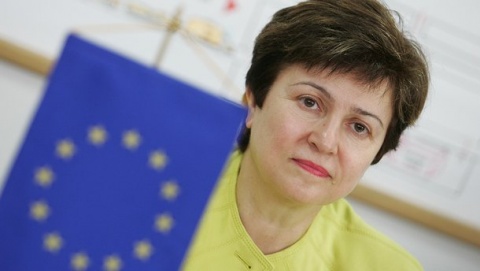
Address by Ms. Kristalina Georgieva
European Commissioner for International Cooperation, Humanitarian Aid and Crisis Response
Your Eminence, Excellencies, dear participants
And foremost - dear volunteers!
1. Introduction
Let me first of all express my gratitude to be able to speak to you today in this location. I am truly honoured to be able to represent the European Commission to this event marking the European Year of Volunteering 2011. I would like to thank wholehartedly the Holy Father for honouring the work of volunteers.
In all religions, Solidarity, caring about the other, 'caritas' - is a core value. Christian religion invites us to see others as our brothers and sisters, our neighbours, and to care about their wellbeing as we care about ours.
Those who engage to improve the lives of others are cherished in all religious communities. What a nice thing to think of volunteers all over the globe as the one red thread that goes through all societies and all religions and as their biggest common denominator. This makes them the Ambassadors for inter-religious dialogue.
In Europe, we can be proud of our strong traditions in charitable work. In fact, tomorrow, when we celebrate the 1918 armistice, it is also the commemoration of Saint Martin, the European Saint of Charity,– European because he was born in Hungary, educated in Italy and was a bishop in France.
In modern days, it was another European, Mother Teresa, who became a symbol of caring or others. In 1979, she received the Nobel peace prize for establishing the Missionaries of Charity. In her own words, she did it to care for "the hungry, the naked, the homeless, the crippled, the blind, the lepers, all those people who feel unwanted, unloved, uncared for throughout society, people that have become a burden to the society and are shunned by everyone." By the time of her death, she had created 610 missions in 123 countries.
Pause a moment - Can you imagine the life of our parishes without all those who are engaged in voluntary church councils; in organizing youth groups; in leading the church choir; in ensuring that the life of the church is lively, active and that members of the religious community – whoever they are - can participate?
Can you imagine the World Youth Day that was celebrated in August in Madrid without those 40,000 volunteers who gave their time and energy to support the logistics and organisation; to show the young people coming from all over the world their way; and to simply make them feel welcomed to Madrid?
Can you actually imagine society at large without volunteer fire fighters? Without the trainers in our local sports clubs? Without all those who have an open ear and helping hand for those members in our communities who are ill, alone or in despair?
I cannot.
2. Volunteers care about society – the EU cares about volunteers
Volunteers care about society. And I am here to say that European Union cares about volunteers. The discussion today is a true mirror of what the Volunteers think. In Europe, 3 out of 10 Europeans tell us they are active as volunteers and close to 80% of respondents feel that voluntary activities are an important part of democratic life in Europe. This means that more than 100 million Europeans volunteer in some capacity and make a difference to our society. And 16 million of them do so in a religious organisation. As a European, I am proud to see that volunteering is in the DNA of Europeans!
There are of course many traditions of volunteering all over Europe; many ways in which citizens get active; different motivations behind such an engagement; and also changing patterns from 'life time commitments' to more sporadic, one-off volunteer experiences. However, what is common, is that wherever people engage together in activities to help each other; to support those in need; to preserve our environment; to campaign for human rights; or to make our religious communities thriving - both society as a whole and the individual volunteers benefit and fundamental values such as social cohesion and solidarity are significantly strengthened.
For this reason, it is important that in these more difficult days the European Union has declared 2011 to be the European Year of Volunteering - to thank all volunteers for their relentless efforts. The European year is there to make these contributions more visible, to show we care about volunteering.
We need you !
3. The European Voluntary Humanitarian Aid Corps as a programme for solidarity – and a lasting legacy of the Year 2011
This year of volunteering is also ideal to launch a new programme: the European Voluntary Humanitarian Aid Corps. When looking at the last two years, this action is more needed than ever before. The earthquake in Haiti; the devastating floods in Pakistan and just now in Thailand; the triple disaster in Japan; the unimaginable droughts in the Horn of Africa; the fighting in Soudan and Somalia. I close my eyes and see all these disasters. I see Ishmael, a boy who had to crawl though camps in yemen. I see kids inhe Horn of Africa that are severely malnourished. I see a 90 year old woman who has lost everything in Japan.
But I also see the faces of those who are there to help, such as the Kenyan doctor who left his home in Nairobi and his stable salary to come and care for those in the camps. I see the family and fellow villagers helping the 90 year old in Japan.
And facing these crises, I am proud to say: Europe cares! And Europe acts, including through the largest humanitarian budget worldwide. And, since I came into office in February 2010, I have also made one of my priorities to add a human face to this support. With disasters on the increase, we have to nurture the spirit of volunteering in Europe.
The European Voluntary Humanitarian Aid Corps will give the opportunity for Europeans to get actively involved in EU humanitarian operations and show solidarity in action – this time with those countries and people on our planet that need it most. Europeans are keen to help with cash – but they are also keen to help with their hands where they are needed.
The experience of recent mega-disasters proves that the humanitarian community sorely lacks enough competent, trained staff to deal with the many crises that are happening in parallel. But they also show that the engagement of people wanting to help need to be well managed. Nothing can be worse than a situation as in Haiti where the goodwill of many volunteers on the island was at times doing more harm than good. This is why we hope that the Voluntary Corps can make a difference for the whole sector, in proferssionalism and coordination.
We launched during the European Year of Volunteering 3 pilot projects inviting our humanitarian partner organisations to test how the future Corps can look like. Organisations such as Save the Children, the Red Cross movement or Voluntary Service Overseas (VSO) have offered projects and will select, recruit, train, and deploy the first humanitarian volunteers of the EU. I am particularly delighted that the Czech Caritas is also part of these pilot actions.
Already the first 100 volunteers are being mobilised and 25 of these volunteers from 10 nationalities have recently spent 4 weeks in Wales to get trained by Save the Children on logistics of humanitarian operations; first aid and security; project management of emergency response; and have gone through a field scenario exercise before being sent mid October to 14 countries all over the globe from Haiti to Indonesia; and from Mozambique to Tajikistan. We will be following their experience and learning – and invite you to also do so on my blog, where some of these will report their stories.
There, I will follow Anna, a Polish volunteer from Wroclaw who is now in Tanzania. And I will follow Colm, from Ireland, whose first placement with Save the Children is as Logistics Officer in Haiti. Colm is also a physiotherapist, so he’s particularly interested in the work of organizations like Handicap International in Haiti. Both he and Anna see this as an opportunity to take the first step in a career in the humanitarian sector. Their experiences – and those of others participants in our pilot projects – will help us develop the Humanitarian Corps.
These are just our first examples, as we are still in a crucial phase in preparing this programme until mid 2012 when we will propose the final set-up of the Corps. In the meantime, the next project, this time organized by the Red Cross, is about to start and you will be informed on our websites on opportunities to get involved.
Let me conclude by inviting you to try to be part of this adventure and to share your views about it. Through this, we will also shape further together the humanitarian corps. When do you have the chance to get involved in a very early stage of a brand-new European programme process and have a real influence?
I come from Bulgaria, where volunteering was sometimes too strongly encouraged by the authorities during communism. As some people still resent this, we together need to give a new meaning to giving and sharing. Let's share volunteering stories so that we encourgae young Europeans to give and share again !
Thank you.