OFFICE FOR THE LITURGICAL CELEBRATIONS
OF THE SUPREME PONTIFF
GOOD FRIDAY
PASSION OF THE LORD
WAY OF THE CROSS LED BY HIS HOLINESS POPE FRANCIS
COLOSSEUM
ROME, 25 MARCH 2016
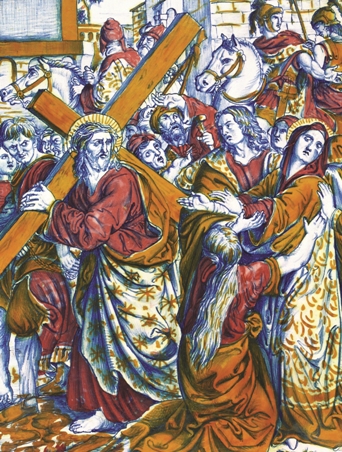
“GOD IS MERCY”
MEDITATIONS
by
Cardinal Gualtiero Bassetti
Archbishop of Perugia – Città della Pieve
[ Arabic, English, French, German, Italian, Portuguese, Slovenian, Spanish]
INTRODUCTION
Blessed be the God and Father of our Lord Jesus Christ,
the Father of mercies and the God of all consolation (2 Cor 1:3)
In this extraordinary Jubilee Year, we are drawn to the Way of the Cross of Good Friday by a particular power, the mercy of our Heavenly Father, who wishes to fill us with his Spirit of grace and consolation.
Mercy is the channel of grace which God bestows upon all the people of today: men and women too often lost and confused, materialistic and idolatrous, poor and alone, who belong to a society that seems to have abandoned the notion of sin and truth.
“They will look on him whom they have pierced” (Zech 12:10). This evening, may the prophetic words of Zechariah be fulfilled in us! May our gaze rise from our abject poverty to look upon him, Christ our Lord, he who is Merciful Love. Then we will be able to see his face and hear him say: “I have loved you with an everlasting love” (Jer 31:3). By his forgiveness, he wipes away our sins and opens to us the way of holiness, on which we will embrace our cross, together with him, out of love for our brothers and sisters. The font which has washed away our sins will become in us “a spring of water welling up to eternal life” (Jn 4:14).
Brief moment of silence
Let us pray.
Eternal Father,
through the Passion of your beloved Son,
you wished to reveal to us your heart
and bestow upon us your mercy.
In union with Mary, his Mother and ours,
may we know how to always welcome and protect the gift of love.
May she, the Mother of Mercy,
present you with the prayers
we raise for ourselves and for all humanity,
so that the grace of this Way of the Cross
may reach every human heart
and fill them with new hope,
that unfailing hope
which radiates from the cross of Jesus.
Who lives and reigns with you
and the Holy Spirit
for ever and ever. Amen.
The First Station
Jesus is condemned to death
V. Adoramus te, Christe, et benedicimus tibi.
R. Quia per sanctam crucem tuam redemisti mundum.
From the Gospel according to Mark (15:14-15)
Pilate said to them, “What evil has he done?” But they shouted all the more, “Crucify him!”. So Pilate, wishing to satisfy the crowd, released for them Barabbas; and having scourged Jesus, he delivered him to be crucified.
Jesus is alone before the powers of this world. He subjects himself completely to human justice. Pilate finds himself before a mystery which he cannot understand. He asks questions and demands explanations. He is searching for a solution and he almost makes it to the threshold of truth. But he decides not to cross it. Between life and the truth, he chooses his own life. Between the present and eternity, he chooses the present.
The crowd chooses Barabbas and abandons Jesus. The crowd wants earthly justice and the one who they think can bring it about; they abandon the man who could free them from oppression and from the yoke of slavery. But Jesus’ justice is not brought about through a revolution; it comes by way of the scandal of the cross. Jesus casts aside every plan for liberation because he takes upon himself the evil of the world, and he does not respond to evil with evil. The people do not understand that from the defeat of man can come the justice of God.
Today each of us is an integral part of that crowd which cries out “Crucify him!”. None of us are exempted. The crowd and Pilate, in fact, are driven by a sentiment that unites all people: fear. Fear of losing their security, their possessions, their life. But Jesus shows us another way.
Lord Jesus,
how similar we are to these people.
How much fear there is in our life!
We are afraid of those different from us, foreigners, migrants.
We are afraid of the future, of the unexpected, of misery.
How much fear there is in our families, our workplaces, our cities…
And perhaps we are also afraid of God: the fear of divine justice born of little faith, poor self-knowledge, and doubtfulness of his mercy.
Lord Jesus, condemned by men and women full of fear, free us from fear of your judgment.
Do not allow our anguished cries to prevent us from hearing your gentle invitation: “Be not afraid!”
All:
Pater noster, qui es in caelis:
sanctificetur nomen tuum;
adveniat regnum tuum;
fiat voluntas tua, sicut in caelo, et in terra.
Panem nostrum cotidianum da nobis hodie;
et dimitte nobis debita nostra,
sicut et nos dimittimus debitoribus nostris;
et ne nos inducas in tentationem;
sed libera nos a malo.
Stabat Mater dolorosa
iuxta crucem lacrimosa,
dum pendebat Filius.
The Second Station
Jesus takes up his cross
V. Adoramus te, Christe, et benedicimus tibi.
R. Quia per sanctam crucem tuam redemisti mundum.
From the Gospel according to Mark (15:20)
When they had mocked him, they stripped him of the purple cloak, and put his own clothes on him. And they led him out to crucify him.
Fear passed judgment, but is not able to reveal itself and so hides behind worldly conduct: mocking, humiliation, violence and derision. Jesus is now robed in his garments, in his humanity alone, sorrowful and bloody, without any royal colours or other sign of his divinity. And this is how Pilate presents him: “Behold the man!” (Jn 19:5).
This is the condition of all who follow Christ. A Christian does not seek the world’s approval or the consensus of public opinion. A Christian does not flatter or lie to gain power. A Christian accepts the mockery and derision which come from love of the truth.
“What is truth?” (Jn 18:38), Pilate asked Jesus. This is a question for every age, including our own. Behold truth: the truth of the Son of Man foretold by the Prophets (cf: Is 52:13-53:12), a disfigured human face which reveals God’s faithfulness.
Too often, however, we go off in search of a cheap truth, which may offer comfort to our lives, and may respond to our insecurities and even satisfy our basest curiosities. And so, we content ourselves with partial and apparent truths, fooled by “the prophets of doom who always proclaim the worst” (Saint John XXIII) or skilled pipers who lull our hearts with alluring music that draws us away from the love of Christ.
The Word of God became man,
and came to share with us the truth in its entirety, about God and about man.
It is God who takes up the cross (cf. Jn 19:17)
and sets out on the path of merciful self-giving.
And the man fulfilled in truth is the one who follows this same path.
Lord Jesus, may we contemplate you in the theophany of the cross, the height of your revelation, and may we recognize ourselves in the mysterious splendour of your face.
All:
Pater noster, qui es in caelis:
sanctificetur nomen tuum;
adveniat regnum tuum;
fiat voluntas tua, sicut in caelo, et in terra.
Panem nostrum cotidianum da nobis hodie;
et dimitte nobis debita nostra,
sicut et nos dimittimus debitoribus nostris;
et ne nos inducas in tentationem;
sed libera nos a malo.
Cuius animam gementem,
contristatam et dolentem
pertransivit gladius.
The Third Station
Jesus falls for the first time
V. Adoramus te, Christe, et benedicimus tibi.
R. Quia per sanctam crucem tuam redemisti mundum.
From the Book of the Prophet Isaiah (53:4, 7)
And yet ours were the sufferings he bore, ours were the sorrows he carried. But we, we thought of him as someone punished, struck by God and brought low. Harshly dealt with, he bore it humbly, he never opened his mouth, like a lamb that is led to the slaughter-house, like a sheep that is dumb before its shearers, never opening his mouth.
Jesus is the lamb, foretold by the prophet, who bears the burden of all humanity’s sin. He takes upon himself the weakness of those whom he loves, their sorrows and offenses, their iniquities and misfortunes. We have come to the extreme limits of the incarnation of the Word. But there is yet a lower point: Jesus falls under the weight of this cross. A God who falls!
In this fall, Jesus gives meaning to humanity’s suffering. Suffering can at times seem to us an absurdity, incomprehensible to the mind, an omen of death. There are moments of suffering which seem to deny God’s love. Where is God in death camps? Where is he in mines and factories where children work like slaves? Where is God in the boats sinking in the Mediterranean?
Jesus falls under the weight of the cross, but he is not crushed by it. Behold, Christ is there; an outcast among outcasts, a failure among so many other failures, a fallen victim among so many shipwrecked souls.
God takes all of this upon himself; a God who out of love does not show his omnipotence. But in that way, precisely in that way, having fallen on the ground like a grain of wheat, God is faithful to himself: faithful in love.
We pray to you, Lord,
for all those moments of suffering which seem to make no sense,
for Jews who died in the death camps,
for Christians killed out of hatred towards the faith,
for victims of every persecution,
for children enslaved through work,
for the innocent who die in war.
Help us understand, Lord, how great is the freedom and interior strength in this unprecedented revelation of your divinity, so human as to fall under the cross of humanity’s sins, so merciful in divinity as to defeat the evil which was oppressing us.
All:
Pater noster, qui es in caelis:
sanctificetur nomen tuum;
adveniat regnum tuum;
fiat voluntas tua, sicut in caelo, et in terra.
Panem nostrum cotidianum da nobis hodie;
et dimitte nobis debita nostra,
sicut et nos dimittimus debitoribus nostris;
et ne nos inducas in tentationem;
sed libera nos a malo.
O quam tristis et afflicta
fuit illa benedicta
Mater Unigeniti!
Fourth Station
Jesus meets his Mother
V. Adoramus te, Christe, et benedicimus tibi.
R. Quia per sanctam crucem tuam redemisti mundum.
From the Gospel according to Luke (2:34-35, 51)
Simeon blessed them and said to Mary his mother, “Behold, this child is set for the fall and rising of many in Israel, and for a sign that is spoken against (and a sword will pierce through your own soul also), that thoughts out of many hearts may be revealed”… And his mother kept all these things in her heart.
God wanted life to come into the world through the pangs of childbirth: by means of the suffering of a mother who brings life into the world. All of us need a Mother, even God. “The Word became flesh” (Jn 1:14), in the womb of a Virgin. Mary received him, brought him to the light of day in Bethlehem, wrapped him in swaddling clothes, protected him and raised him with the warmth of her love; and she accompanied him to his “hour”. Now, at the foot of Calvary, the prophecy of Simeon is fulfilled: a sword pierces her heart. Mary sees her Son once again, disfigured and exhausted under the weight of the cross. Her eyes filled with a mother’s sorrow, Mary shares to the very end in her Son’s suffering; and yet her eyes are also full of hope. From the day of her “yes” to the Angel’s message (cf. Lk 1:26-38), her eyes have never stopped reflecting the divine light which shines forth even on this day of suffering.
Mary is Joseph’s spouse, and Jesus’ mother. Then, as now, the family is the beating heart of society; the inalienable cell of everyday life; the irreplaceable lintel of human relations; unending love that will save the world.
Mary is woman and mother. Feminine sensitivity and tenderness. Wisdom and charity. As the mother of all, Mary “is a sign of hope for peoples suffering the birth pangs of justice. She is the missionary who draws near to us and accompanies us throughout life, opening our hearts to faith by her maternal love. As a true mother, she walks at our side, she shares our struggles and she constantly surrounds us with God’s love” (Evangelii Gaudium, 286).
O Mary, Mother of the Lord,
you were the first reflection of the Father’s mercy for your divine Son,
the mercy which you asked of him at Cana.
As your Son reveals his Father’s countenance to us
even to the supreme consequences of love,
you place yourself silently on his path,
the first disciple of the Cross.
O Mary, faithful Virgin,
look after all the orphans of our world,
protect all women subject to exploitation and violence.
Bring forth courageous women for the good of the Church.
Inspire every mother to teach her own children the tenderness of God’s love,
and, in the hour of trial, to accompany them on their way
with the silent strength of her faith.
All:
Pater noster, qui es in caelis:
sanctificetur nomen tuum;
adveniat regnum tuum;
fiat voluntas tua, sicut in caelo, et in terra.
Panem nostrum cotidianum da nobis hodie;
et dimitte nobis debita nostra,
sicut et nos dimittimus debitoribus nostris;
et ne nos inducas in tentationem;
sed libera nos a malo.
Quae moerebat et dolebat,
pia Mater, dum videbat
Nati poenas incliti.
Fifth Station
Simon of Cyrene helps Jesus carry the Cross
V. Adoramus te, Christe, et benedicimus tibi.
R. Quia per sanctam crucem tuam redemisti mundum.
From the Gospel according to Mark (15:21-22)
They compelled a passer-by, Simon of Cyrene, who was coming in from the country, the father of Alexander and Rufus, to carry Jesus’ cross. And they brought him to the place called Golgotha (which means the place of the skull).
In the history of salvation an unknown man appears. Simon of Cyrene, a worker who was returning from the fields, is forced to carry the cross. It is in him that the grace of the love of Christ, which passes through the Cross, first begins to act. And Simon, forced to carry this weight against his own will, becomes a disciple of the Lord.
Suffering, when it knocks at our door, is never expected. It always appears as a limitation, sometimes even an injustice. And it can find us dramatically unprepared. An illness could ruin our life’s plans. A disabled child could disturb the dreams of motherhood so long desired. That unwelcome ordeal, however, knocks forcefully on the hearts of men and women. How do we behave when confronted with the suffering of someone we love? How attentive are we to the cry of someone suffering who lives far from us?
The Cyrenean helps us to enter into the fragility of the human soul and reveals another aspect of Jesus’ humanity. For even the Son of God needed someone to help him carry the cross. Who then is the Cyrenean? He is God’s mercy made present in the history of mankind. God gets his hands dirty with us, with our sins and our frailty. He is not ashamed of this. And he does not abandon us.
Lord Jesus,
we thank you for this gift which surpasses our every hope
and which reveals your mercy to us.
Not only have you loved us by granting us salvation,
but also by making us instruments of salvation.
While your cross gives meaning to every cross,
to us is given the supreme grace in life:
to participate actively in the mystery of redemption,
to be instruments of salvation for our brothers and sisters.
All:
Pater noster, qui es in caelis:
sanctificetur nomen tuum;
adveniat regnum tuum;
fiat voluntas tua, sicut in caelo, et in terra.
Panem nostrum cotidianum da nobis hodie;
et dimitte nobis debita nostra,
sicut et nos dimittimus debitoribus nostris;
et ne nos inducas in tentationem;
sed libera nos a malo.
Quis est homo qui non fleret.
matrem Christi si videret
in tanto supplicio ?
Sixth Station
Veronica wipes the face of Jesus
V. Adoramus te, Christe, et benedicimus tibi.
R. Quia per sanctam crucem tuam redemisti mundum.
From the Book of the Prophet Isaiah (53:2-3)
He had no form or comeliness that we should look at him, and no beauty that we should desire him. He was despised and rejected by men; a man of sorrows, and acquainted with grief; and as one from whom men hide their faces he was despised, and we esteemed him not.
Amidst the confusion of the crowd following Jesus to Calvary, Veronica appears, a woman whose face and life is unknown. And yet she is a courageous woman, ready to listen to the Spirit and to follow his inspirations. She is able to recognize the glory of the Son of God in the marred face of Jesus, and to perceive his invitation to her: “All you who pass by, look and see if there is any sorrow like my sorrow” (Lam 1:12).
Love, which this woman incarnates, leaves us speechless. Love renders her strong enough to challenge the guards, to overcome the crowd, to draw close to the Lord and perform an act of compassion and faith: stopping the blood from his wounds, drying his tears of pain, contemplating his disfigured face, behind which hides the face of God.
We instinctively try to run away from suffering, because suffering is repugnant to us. We come across so many faces disfigured by the afflictions of life and too often we turn away. How can we not see the face of the Lord in the face of the millions of exiles, refugees, and displaced persons who are fleeing in desperation from the horror of war, persecution and dictatorship? For every one of them, each with a unique face, God reveals himself always as the one who courageously comes to our aid. Like Veronica, the woman whose face is unknown to us, who lovingly wiped Jesus’ face.
“Your face, o Lord, do I seek” (Ps 27:8).
Help me to see your face in my brothers and sisters
who walk the way of pain and humiliation.
Teach me to dry the tears and blood of those trodden down in every age,
of all those ruthlessly cast aside by a rich and careless society.
Help me to glimpse your face of infinite beauty behind every human face,
even the most abandoned.
All:
Pater noster, qui es in caelis:
sanctificetur nomen tuum;
adveniat regnum tuum;
fiat voluntas tua, sicut in caelo, et in terra.
Panem nostrum cotidianum da nobis hodie;
et dimitte nobis debita nostra,
sicut et nos dimittimus debitoribus nostris;
et ne nos inducas in tentationem;
sed libera nos a malo.
Quis non posset contristari,
Christi Matrem contemplari
dolentem cum Filio?
Seventh Station
Jesus falls for the second time
V. Adoramus te, Christe, et benedicimus tibi.
R. Quia per sanctam crucem tuam redemisti mundum.
From the Book of the Prophet Isaiah (53:5)
He was wounded for our transgressions, he was bruised for our iniquities; upon him was the chastisement that made us whole, and with his stripes we are healed.
Jesus falls again. Crushed but not killed by the weight of the cross. Once again he bares his humanity. It is an experience of the limits of powerlessness, of shame in front of those mocking him, of humiliation before those who had hoped in him. No one ever wants to fall and experience failure, especially in front of other people.
People often rebel against the idea of having no power, of being unable to move ahead in life. Jesus, instead, embodies the “power of the powerless”. He experiences the torment of the cross and the salvific power of faith. Only God can save us. Only he can transform a sign of death into a glorious cross.
If Jesus has fallen to the ground a second time by the weight of our sin, then we must also accept our falls, that we have fallen in the past, and that we are capable of falling again by our sins. Let us recognize our inability to save ourselves by our own strength.
Lord Jesus, who accepted the humiliation of falling again
as everyone looked on,
we would like not only to contemplate you lying in the dust,
but to do so from where we ourselves have fallen due to weaknesses.
Make us aware of our sins,
and give us the will, born of pain, to get up again.
Bestow upon your whole Church the awareness of suffering.
Offer especially to your ministers of Reconciliation the gift of tears for their own sins.
How can they beseech your mercy for themselves and others
if they do not first know how to mourn their own faults?
All:
Pater noster, qui es in caelis:
sanctificetur nomen tuum;
adveniat regnum tuum;
fiat voluntas tua, sicut in caelo, et in terra.
Panem nostrum cotidianum da nobis hodie;
et dimitte nobis debita nostra,
sicut et nos dimittimus debitoribus nostris;
et ne nos inducas in tentationem;
sed libera nos a malo.
Pro peccatis suae gentis
vidit Iesum in tormentis
et flagellis subditum.
The Eighth Station
Jesus meets the women of Jerusalem
V. Adoramus te, Christe, et benedicimus tibi.
R. Quia per sanctam crucem tuam redemisti mundum.
From the Gospel according to Luke (23:27-28)
And there followed him a great multitude of the people, and of women who bewailed and lamented him. But Jesus turning to them said, “Daughters of Jerusalem, do not weep for me, but weep for yourselves and for your children”.
Jesus, overcome with pain and seeking consolation from the Father, still feels compassion for the people following him. He turns to the women accompanying him on the way to Calvary; his is a powerful call to conversion.
Do not weep for me, says the Nazarene, because I am doing my Father’s will. Rather weep for yourselves and all those occasions that you fail to do God’s will.
It is the Lamb of God who speaks and who in carrying the sin of the world purifies the gaze of these daughters, which is already turned towards him, though still imperfectly. To the Innocent one, their grief seems to cry out: “What must we do?” This is the same question which the crowds had put to the Baptist (cf. Lk 3:10), and which was repeated by Peter’s contrite listeners after Pentecost: “What must we do?” (Acts 2:37).
The response is clear and simple: “Repent”. A conversion that is personal and communal. “Pray for one another, that you may be healed” (Jas 5:16). There is no conversion without charity. And charity is the way of the Church.
Lord Jesus,
may your grace sustain our journey of conversion
so that we can turn to you,
in communion with our brothers and sisters,
on whom we ask you to bestow your infinite mercy,
and, with a love as deep as a mother’s,
enable us to be tender and compassionate towards one another,
even to giving our very selves for the salvation of our neighbour.
All:
Pater noster, qui es in caelis:
sanctificetur nomen tuum;
adveniat regnum tuum;
fiat voluntas tua, sicut in caelo, et in terra.
Panem nostrum cotidianum da nobis hodie;
et dimitte nobis debita nostra,
sicut et nos dimittimus debitoribus nostris;
et ne nos inducas in tentationem;
sed libera nos a malo.
Etia, Mater, fons amoris,
me sentire vim doloris
fac, ut tecum lugeam.
The Ninth Station
Jesus falls for the third time
V. Adoramus te, Christe, et benedicimus tibi.
R. Quia per sanctam crucem tuam redemisti mundum.
From the Letter to the Philippians (2:6-7)
Though he was in the form of God, Jesus did not count equality with God something to be grasped, but rather emptied himself, taking the form of a servant, being born in the likeness of men.
Jesus falls for the third time. The son of God experiences the depths of the human condition. With this fall he enters even more fully into the history of humanity. He accompanies suffering humanity in every moment: “I am with you always, to the close of the age” (Mt 28:20).
How often men and women fall! How often men, women and children suffer because of a broken family! How often men and women believe they have no dignity because they have no work. How often young people are forced to live in uncertainty, leading them to lose hope for the future!
The person who falls, and who contemplates the God who has fallen, is the man or woman who finally can admit their own weakness and powerlessness without fear or despair, precisely because God has experienced the same through his Son. It is out of mercy that God abases himself to this extent, to the point of lying prostrate in the dust of the street. Dust dampened by the sweat of Adam and the blood of Jesus and all the martyrs of history; the dust blessed by the tears of so many of our brothers and sisters who have fallen victim to violence and exploitation. It is for this dust – blessed, violated, desecrated and despoiled by human selfishness – that the Lord saved his last embrace.
Lord Jesus,
prostrated on this parched earth,
you are near to all who suffer;
you place in their hearts the strength to rise again.
I pray, God of mercy,
for all who have fallen for whatever reason:
personal sin, marriages which have broken down, loneliness,
loss of work, family difficulties, worry for the future.
Help them to know that you are not far from them,
because those closest to you, who are Mercy incarnate,
are those most aware of their need for forgiveness
and who continue to hope against all hope!
All:
Pater noster, qui es in caelis:
sanctificetur nomen tuum;
adveniat regnum tuum;
fiat voluntas tua, sicut in caelo, et in terra.
Panem nostrum cotidianum da nobis hodie;
et dimitte nobis debita nostra,
sicut et nos dimittimus debitoribus nostris;
et ne nos inducas in tentationem;
sed libera nos a malo.
Fac, ut ardeat cor meum
in amando Christum Deum,
ut sibi complaceam.
The Tenth Station
Jesus is stripped of his garments
V. Adoramus te, Christe, et benedicimus tibi.
R. Quia per sanctam crucem tuam redemisti mundum.
From the Gospel according to Mark (15:24)
And they crucified him, and divided his garments among them, casting lots for them, to decide what each should take.
At the foot of the cross, beneath the Crucified One and the suffering criminals, there are the soldiers arguing over Jesus’ garments. This is the banality of evil.
The expression on the soldiers’ faces is so distant and far removed from the suffering and events unfolding around them. It is as if it does not affect them. While the Son of God is undergoing the torments of the cross, they continue undeterred to live a life ruled exclusively by their passions. This is the great paradox of the freedom that God has granted to his own children. Faced with Jesus’ death, every man and woman is able to choose: to contemplate Christ or to “cast lots”.
The distance between the Crucified One and his executioners is vast. The pitiful game played for the garments does not allow them to grasp the meaning of that defenceless and despised body, mocked and martyred, in which the divine will is accomplished for the salvation of all humanity.
The body which the Father “prepared” for his Son (cf. Ps 40:7; Heb 10:5) now reveals the love of the Son for his Father and the total gift of Jesus to humanity. That body stripped of everything except love, contains in itself the immense suffering of humanity and reveals all its wounds; above all, the most painful ones: the wounds of children who have been violated.
That silent and bloodied body, scourged and humiliated, shows the path of justice; the justice of God which transforms the most atrocious suffering by the light of the resurrection.
Lord Jesus,
I want to bring you all of suffering humanity.
The bodies of men and women, of children and the elderly, of the sick and disabled whose dignity is not respected.
So much violence through history has struck what is most intimate in humanity, what is sacred and blessed because it comes from God.
We pray, Lord, for those who have been violated to the depths of their being.
For those unable to appreciate the mystery of their own body, for those unable to accept beauty or who disfigure it, for those who do not respect the vulnerability and sanctity of the body that ages and dies.
And that, one day, will rise again!
All:
Pater noster, qui es in caelis:
sanctificetur nomen tuum;
adveniat regnum tuum;
fiat voluntas tua, sicut in caelo, et in terra.
Panem nostrum cotidianum da nobis hodie;
et dimitte nobis debita nostra,
sicut et nos dimittimus debitoribus nostris;
et ne nos inducas in tentationem;
sed libera nos a malo.
Santa Mater, istud agas,
crucifixi fige plagas
cordi meo valide.
The Eleventh Station
Jesus is crucified
V. Adoramus te, Christe, et benedicimus tibi.
R. Quia per sanctam crucem tuam redemisti mundum.
From the Gospel according to Luke (23: 39-43)
One of the criminals who were hanged railed at Jesus, saying, “Are you not the Christ? Save yourself and us!” But the other rebuked him, saying, “Do you not fear God, since you are under the same sentence of condemnation? And we indeed justly; for we are receiving the due reward of our deeds; but this man has done nothing wrong.” And he said, “Jesus, remember me when you come into your kingdom.” And Jesus said to him, “Truly, I say to you, today you will be with me in paradise.”
Jesus is on the cross, the “lovely and refulgent tree”, “nuptial bed, throne and altar” (Liturgical Hymn Behold the Banner of the Cross). From the heights of this throne, the focal point of the entire universe (cf. Jn 12:32), Jesus forgives his persecutors “because they know not what they are doing” (Lk 23:24). On Christ’s cross, “the instrument of our redemption” (Behold the Banner of the Cross), shines forth an omnipotence which reveals itself, a wisdom which humbles itself to the point of folly, a love which offers itself in sacrifice.
On either side of Jesus are two criminals, probably murderers. These two criminals speak to the heart of every person because they show two different ways of being on the cross: the first one curses God; the second recognizes God on the cross. The first criminal proposes a solution which is more comfortable for everyone. He proposes a human salvation and he only looks downwards. Salvation for him is escaping from the cross and eliminating suffering. It is the mentality of a throwaway culture. He asks God to eliminate everything that is not useful and unworthy of being experienced.
The second criminal, however, does not bargain. He proposes a divine salvation, keeping his gaze turned entirely towards heaven. For him, salvation means accepting the will of God even in the worst conditions. It is the triumph of a culture of love and forgiveness.
It is the folly of the cross against which all human wisdom can only fade away and fall silent.
O Crucified One, nailed to the cross out of love,
grant me your forgiveness which forgets,
and your mercy which creates anew.
May I experience, in every confession,
the grace that created me in your image and likeness
and that renews me every time I entrust my life,
with all of its sufferings, to the merciful hands of the Father.
May your forgiveness resound for me
as the assurance of a love that saves me,
that makes me new and allows me to remain with you for ever.
Then I shall be truly a wrongdoer who is graced,
and each time you pardon me will be like
a foretaste of Heaven, from this day onwards.
All:
Pater noster, qui es in caelis:
sanctificetur nomen tuum;
adveniat regnum tuum;
fiat voluntas tua, sicut in caelo, et in terra.
Panem nostrum cotidianum da nobis hodie;
et dimitte nobis debita nostra,
sicut et nos dimittimus debitoribus nostris;
et ne nos inducas in tentationem;
sed libera nos a malo.
Tui Nati vulnerati,
tam dignati pro me pati,
poenas mecum divide.
The Twelfth Station
Jesus dies on the cross
V. Adoramus te, Christe, et benedicimus tibi.
R. Quia per sanctam crucem tuam redemisti mundum.
From the Gospel according to Mark (15:33-39)
And when the sixth hour had come, there was darkness over the whole land until the ninth hour. And at the ninth hour, Jesus cried with a loud voice, “Eloi, Eloi, lama sabachthani?”, which means, “My God, my God, why have you forsaken me?”. And some of the bystanders hearing it said, “Behold, he is calling Elijah”. And one ran and, filling a sponge full of vinegar, put it on a reed and gave it to him to drink, saying, “Wait, let us see whether Elijah will come to take him down.” And Jesus uttered a loud cry, and breathed his last. And the curtain of the temple was torn in two, from top to bottom. And when the centurion, who stood facing him, saw that he thus breathed his last, he said, “Truly this man was the Son of God!”.
Darkness at midday: something absolutely unheard of and unexpected is happening, which is not only of this world. Man is killing God! The Son of God was crucified as a criminal.
Jesus turns towards the Father, crying out the first words of Psalm 22. It is a cry of suffering and desolation, but also of complete “trust in the divine victory” and of “the certainty of glory” (BENEDICT XVI, Catechesis, 14 September 2011).
The cry of Jesus is that of every crucified person through the ages, everyone who has been abandoned or humiliated, the cry of the martyr and the prophet, of those vilified and unjustly condemned, of those in exile or in prison. It is the cry of human desperation that leads, however, to the victory of faith which transforms death into eternal life. “I will tell of your name to my brethren; in the midst of the congregation I will praise you” (Ps 22:22).
Jesus dies on the cross. Is it the death of God? No, it is the most solemn celebration of the witness of faith.
The twentieth century has been defined as the century of martyrs. Examples such as Maximilian Kolbe and Edith Stein express an immense light. Today too, the Body of Christ is crucified in many parts of the world. The martyrs of the twenty-first century are true apostles of the modern world.
In this great darkness the faith is kindled: “Truly, this man was the Son of God!”, because he who dies in this way, turning the desperation of death into hope for life, cannot be a mere man.
The Crucified One is a total offering.
He has held back nothing, not a shred of his clothing, not a drop of his blood, not even his own Mother.
He has given everything: “Consummatum est”.
When one no longer has anything left to give because he has given everything, then he is able to offer true gifts.
Stripped, naked, overcome with wounds, with thirst due to abandonment, with insults:
It is no longer the image of a man.
To give everything: this is charity.
Where what is mine ends, paradise begins.
(Don Primo Mazzolari)
All:
Pater noster, qui es in caelis:
sanctificetur nomen tuum;
adveniat regnum tuum;
fiat voluntas tua, sicut in caelo, et in terra.
Panem nostrum cotidianum da nobis hodie;
et dimitte nobis debita nostra,
sicut et nos dimittimus debitoribus nostris;
et ne nos inducas in tentationem;
sed libera nos a malo.
Vidit suum dulcem Natum
moriendo desolatum
dum emisit spiritum.
The Thirteenth Station
Jesus is taken down from the cross
V. Adoramus te, Christe, et benedicimus tibi.
R. Quia per sanctam crucem tuam redemisti mundum.
From the Gospel according to Mark (15: 42-43, 46a)
When evening had come, since it was the day of Preparation, that is, the day before the Sabbath, Joseph of Arimathea, a respected member of the council, who was also himself looking for the kingdom of God, took courage and went to Pilate, and asked for the body of Jesus… And he bought a linen shroud, and took him down.
Joseph of Arimathea welcomes Jesus even before he saw his glory. He welcomes him in defeat. As a criminal. As one rejected. He asks Pilate for Jesus’ body so that it will not be thrown into a common grave. Joseph risks his reputation and, perhaps, like Tobit, his life (cf. Tob 1:15-20). But Joseph’s courage is not that of a hero in battle. His courage is the power of faith. A faith that finds expression in openness, selflessness and love. In a word: charity.
In silence, the simplicity and sobriety with which Joseph approaches the body of Jesus contrasts with the ostentation, banality and splendour of the funerals of the powerful of this world. Joseph’s testimony recalls, however, all those Christians who even today put their lives at risk to bury a loved one.
Who would be able to receive the lifeless body of Jesus if not the one who had given him life? We can imagine Mary’s emotions as she received him in her arms, she who believed the words of the Angel and who pondered all these things in her heart.
Mary, as she embraces her lifeless son, repeats once more her fiat. It is the tragedy and the trial of faith. No creature has suffered like Mary, the mother of all of us whom she engendered in faith at the foot of the Cross.
He was repeating the prayer of the world:
“Father, Abba, if it be possible…”
A sprig of olive
rustled silently above his head…
Yet not even a single piercing thorn
did you remove from his crown.
Pierced too were his thoughts,
They too bled on the height of the cross!
Not even one hand
did you pull from the wood:
so that he could wipe from his eyes
the blood
at least to see his Mother,
there alone…
Even the powerful
and the masters of torture
and the people, upon seeing him
covered their faces.
He drifted within a cloud:
the cloud of abandonment by you.
And later, only later,
did you restore life to him, and to us.
(Padre Davide Turoldo)
All:
Pater noster, qui es in caelis:
sanctificetur nomen tuum;
adveniat regnum tuum;
fiat voluntas tua, sicut in caelo, et in terra.
Panem nostrum cotidianum da nobis hodie;
et dimitte nobis debita nostra,
sicut et nos dimittimus debitoribus nostris;
et ne nos inducas in tentationem;
sed libera nos a malo.
Fac me tecum pie flere,
Crucifixo condolere
donec ego vixero.
The Fourteenth Station
Jesus is laid in the tomb
V. Adoramus te, Christe, et benedicimus tibi.
R. Quia per sanctam crucem tuam redemisti mundum.
From the Gospel according to Matthew (27:59-60)
Joseph took the body [of Jesus] and wrapped it in a clean linen shroud, and laid it in his own new tomb, which he had hewn in the rock; and he rolled a great stone to the door of the tomb and departed.
As Joseph is closing the tomb, Jesus is descending into hell to throw open its gates.
What the Church in the West calls “the descent into hell”, the Oriental Churches celebrate as Anastasis, that is, “Resurrection”. The sister Churches in this way express the full truth of this one mystery: “Behold, I will open your graves, and raise you from your graves, O my people… And I will put my Spirit within you, and you shall live” (Ezek 37:12,14).
Your Church, Lord, sings each morning, “Through the tender mercy of our God, when the day shall dawn upon us from on high, to give light to those who sit in darkness and in the shadow of death, to guide our feet into the way of peace” (Lk 1:78-79).
Man, awed by lights which bring only darkness, urged on by the forces of evil, has rolled a large stone and enclosed you, Lord, in the tomb. But we know that you, O humble God, in the silence in which our freedom has placed you, are at work more than ever in order to bring new grace in humanity whom you love. Enter, therefore, into our tombs: rekindle the spark of your love in each man and woman, in the heart of each family, along the path of every people.
O Christ Jesus!
We are all journeying to our own death and our own tomb.
Grant that we may unite ourselves spiritually before your tomb.
May the power of Life manifested there,
pierce our hearts.
Let this Life become the light
of our earthly pilgrimage.
Amen.
(Saint John Paul II)
All:
Pater noster, qui es in caelis:
sanctificetur nomen tuum;
adveniat regnum tuum;
fiat voluntas tua, sicut in caelo, et in terra.
Panem nostrum cotidianum da nobis hodie;
et dimitte nobis debita nostra,
sicut et nos dimittimus debitoribus nostris;
et ne nos inducas in tentationem;
sed libera nos a malo.
Quando corpus morietur,
fac, ut animae donetur
Paradisi gloria.
Amen.


