| The Emperor Constantine, who reigned from 306 A.D. to 332 A.D., ended the persecutions of Christians, by proclaiming the Edict of Milan in 313 A.D., which established freedom of worship. It favours the construction of places of Christian worship, especially that commemorating the Apostle. He ordered the erection of a place of worship above his tomb [1]. One might think that this first building was very small because probably, prior to its construction, there lied the structure of a domus ecclesiae, that is a domestic church. On November 18, 324 A.D. the Basilica was consecrated by Pope Sylvester I (314 A.D. - 335 A.D.). After the important restoration work of 2006, one can notice by observing the ground that the apse was oriented eastward following the custom of the times. The magnificent Basilica of the Three Emperors [2]
In 395 it was consecrated by Pope Silicius (384-399).
In order to enlarge the Basilica, by that time too small for the continuous influx of pilgrims, it became necessary to change its orientation, from East to West.
The style of its structure was Byzantine, measuring 131,66 meters long, 65 meters wide and 30 meters high.
It was built according to a design which specified five naves (a large central nave 29,70 meters long, flanked by four lateral naves) all sustained by a so-called “forest” of 80 monolithic columns made of granite and its quadriportico (70 meters long), that is, a courtyard with four rows of columns. It had been the largest Roman Basilica until the re-construction of St. Peter’s.
Witnessing to the Church’s love for this place, throughout the following centuries the Popes would not cease to restore and embellish it by adding frescoes, mosaics, paintings and chapels.
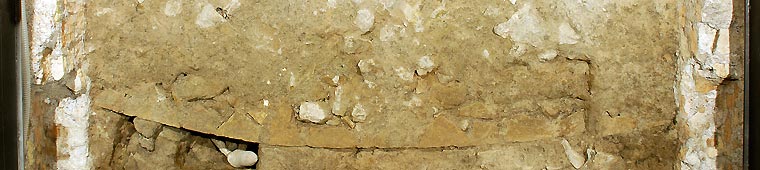
1) The apse of the first Basilica of Constantine, which dates back to the fourth century and is currently visible through a transparent glass floor, was discovered thanks to these important excavations around the tomb. One should not exclude the possibility that these foundations could also contain the remains of the ancient tropaeum, that is, the commemorative monument which was erected above the tomb of the Apostle. 2) In 386 A.D. Theodosius, Arcadius and Valentinian II assigned the work for the new Basilica to the architect Cyriades. The Basilica was completed under Emperor Honorius, according to the inscription on the Triumphal Arch named after Galla Placidia, the sister of the Emperor who financed the project. |



 The Basilica
