| Despite the great invasions during this period, the Popes continued to carry out work on the Basilica: Leo the Great (440-461) ordered the decoration of the Triumphal Arch in mosaic [1] and the re-construction of the roof destroyed by the fire, in order to start the long series of mosaic medallion portraits depicting all the Popes throughout history [2], which would form a high frieze around the transept and nave. Pope Symmachus (498-514) restored the apse and constructed the habitacula for the poorest of pilgrims. The continuing presence of the Benedictine Monks near the tomb of the Apostle dates back to Gregory II (715-731). Leo III (795-816) laid down the first marble slab after the earthquake in 801.
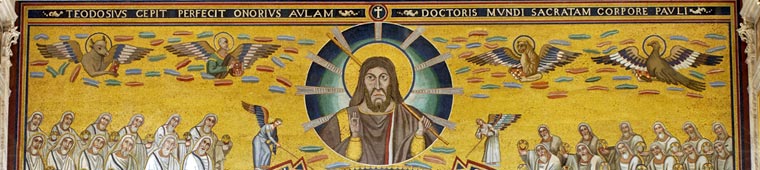
1) This mosaic is tied to the same Venetian school of mosaicists of the Basilica of Saint Mark. In the centre is a Byzantine Christ giving a blessing, flanked by two angels and 24 Ancients of the Apocalypse. Underneath are depictions of the Apostles Peter and Paul, the latter of whom seems to be pointing to his tomb located 15 meters below. This mosaic was touched up and restored several times. Finally it was placed in its definitive and present location after the fire of 1823.
2) This sequence of papal portraits testifies in an extraordinary way to “the pre-eminent authority of the very great, the very ancient, and universally known Church founded and organized at Rome by the two most glorious apostles, Peter and Paul”, as saint Irenaeus wrote in the 2nd century. After the fire of 1823, Gregory XVI requested that the chronological series of papal medallions, characteristic of the Basilica, be reproduced in mosaic. The old medallions that survived the fire are currently preserved in the monastery.
|



 The Basilica


